
How businesses reach people online and why it matters
Digital marketing refers to the use of digital channels, platforms, and technologies to promote products, services, or brands to potential customers. It includes all marketing efforts that use the internet or electronic devices such as websites, search engines, social media platforms, email, mobile applications, and online advertising systems.
According to DataReportal (2024), more than 5.3 billion people worldwide use the internet, which represents over 65% of the global population. This shift in consumer behavior has made digital marketing a necessity rather than an option. Businesses today must meet their audience where they already spend time—online.
Digital marketing involves not only creating content but also distributing, optimizing, and measuring it using data-driven methods. Common techniques include Search Engine Optimization (SEO), Search Engine Marketing (SEM), Pay-Per-Click advertising (PPC), content marketing, social media marketing, and email marketing. Each method plays a specific role in attracting, engaging, and converting users.
Unlike traditional marketing, digital marketing allows businesses to track performance in real time, adjust strategies quickly, and personalize communication at scale.Unlike traditional marketing methods such as print, radio, and television, digital marketing allows businesses to target specific audiences, track performance in real time, and optimize campaigns based on data. To understand this comparison in detail, you can explore our guide on digital-marketing-vs-traditional-marketing, which explains how both approaches differ in reach, cost, and effectiveness.
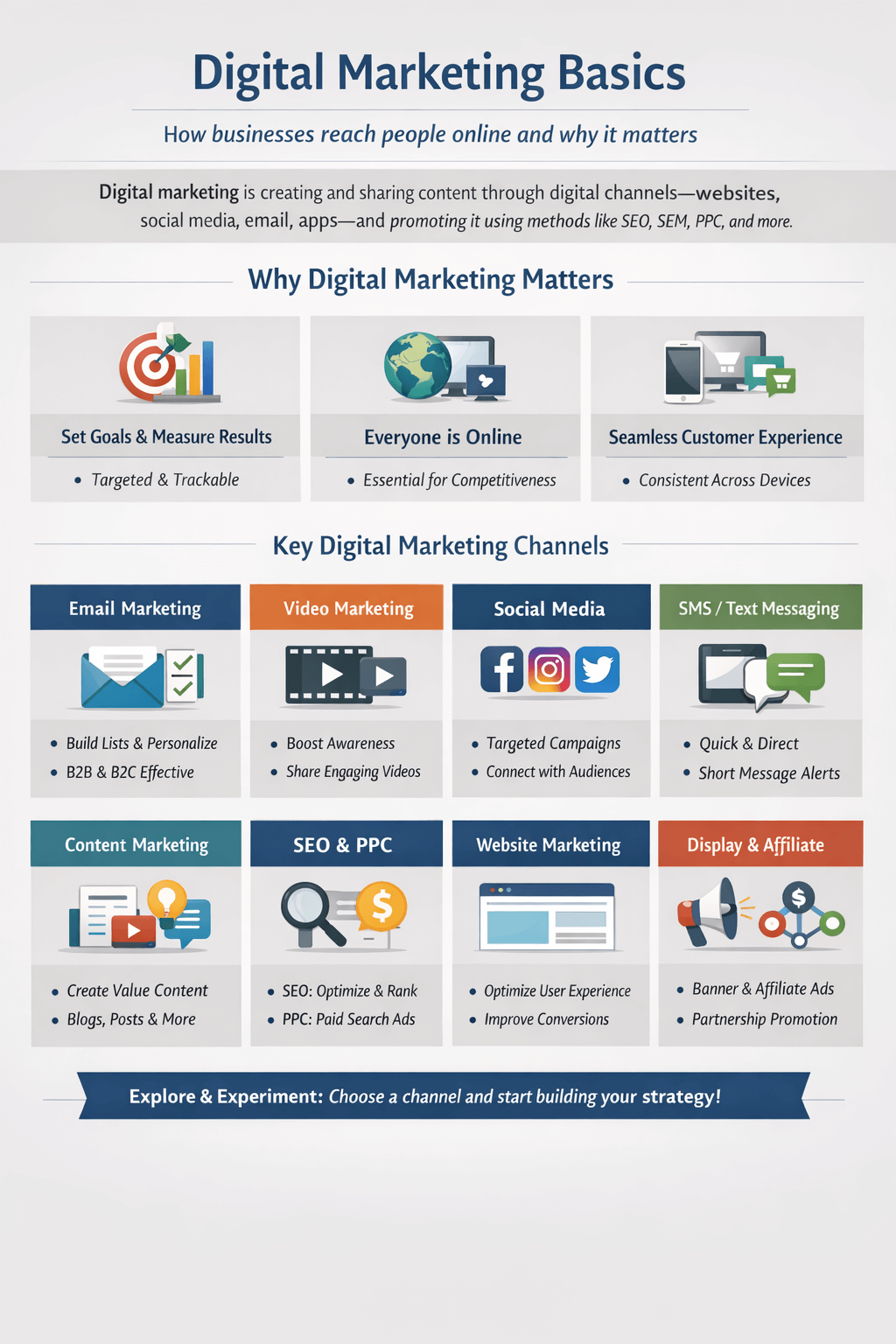
Why Digital Marketing Matters
Set Goals & Measure Results
One of the most important advantages of digital marketing is measurability. Platforms such as Google Analytics, Google Ads, Meta Ads Manager, and email marketing tools allow businesses to track metrics like impressions, clicks, conversions, cost per lead, and return on investment (ROI).
According to Google, data-driven organizations are 3 times more likely to report significant improvements in decision-making. Digital marketing enables businesses to:
- Set clear goals such as traffic growth, lead generation, or sales
- Monitor performance in real time
- Optimize campaigns based on actual user behavior
This level of tracking is difficult to achieve with traditional advertising methods like print or television.
Everyone is Online
Today’s customers rely heavily on digital platforms for research and decision-making. Statista reports that over 90% of consumers research products online before making a purchase, even if they plan to buy offline.
People use search engines to find solutions, social media to discover brands, and review platforms to validate trust. Businesses that lack a digital presence risk losing visibility and credibility.
Being online is no longer about growth alone—it is essential for basic competitiveness, especially in crowded markets.
Seamless Customer Experience
Digital marketing supports a consistent and connected experience across devices such as smartphones, tablets, laptops, and desktops. Consumers often switch between devices during a single buying journey.
According to Google Think Insights, users expect brands to provide a smooth experience regardless of the platform they use. Digital marketing allows businesses to:
- Maintain consistent messaging
- Retarget users across platforms
- Personalize content based on user behavior
This consistency helps build trust and improves conversion rates.
Key Digital Marketing Channels
Email Marketing
Email marketing involves sending targeted messages to a list of subscribers who have shown interest in a brand. Despite being one of the oldest digital channels, it remains highly effective.
According to HubSpot, email marketing delivers an average ROI of $36 for every $1 spent.
Key benefits include:
- Ability to personalize content
- Effective for both B2B and B2C communication
- Direct access to the audience without algorithm dependency
Email marketing is commonly used for newsletters, promotions, onboarding sequences, and customer retention.
Video Marketing
Video marketing focuses on using video content to educate, engage, or convert audiences. Platforms such as YouTube, Instagram, and LinkedIn have made video a dominant content format.
Wyzowl’s 2024 Video Marketing Report states that 91% of businesses use video as a marketing tool, and most marketers report positive ROI.
Video helps businesses:
- Increase brand awareness
- Explain complex ideas easily
- Improve engagement and retention
Educational videos, product demos, and short-form videos are especially effective.
Social Media
Social media marketing involves promoting content and engaging users on platforms such as Facebook, Instagram, Twitter (X), and LinkedIn.
According to DataReportal, the average internet user spends over 2.5 hours per day on social media.
Social media allows brands to:
- Run highly targeted ad campaigns
- Build communities
- Communicate directly with customers
It is particularly effective for brand building, customer engagement, and audience insights.
SMS / Text Messaging
SMS marketing uses text messages to deliver short, time-sensitive information directly to users’ mobile phones.
Research by Gartner shows that SMS messages have an open rate of over 90%, making them one of the most direct communication channels.
Common uses include:
- Transaction alerts
- Appointment reminders
- Limited-time offers
Because of its personal nature, SMS should be used carefully and with user consent.
Content Marketing
Content marketing focuses on creating valuable, relevant, and informative content to attract and retain an audience. This includes blogs, articles, guides, infographics, and case studies.
According to Content Marketing Institute, content marketing costs 62% less than traditional marketing while generating more leads.
Its goals are to:
- Educate users
- Build trust and authority
- Support SEO and lead generation
Content marketing works best as a long-term strategy.
SEO & PPC
SEO (Search Engine Optimization) and PPC (Pay-Per-Click advertising) are two core search marketing methods.
- SEO focuses on improving organic rankings through content, keywords, and technical optimization.
- PPC involves paid ads that appear on search engines and other platforms.
According to BrightEdge, over 50% of website traffic comes from organic search, while PPC provides immediate visibility.
Together, they help businesses:
- Capture high-intent users
- Balance long-term and short-term results
Website Marketing
Website marketing ensures that a website is optimized for user experience, performance, and conversions.
A study by Google found that 53% of mobile users leave a site if it takes longer than 3 seconds to load.
Website marketing focuses on:
- Page speed
- Clear navigation
- Conversion optimization
A website is often the central hub of all digital marketing activities.
Display & Affiliate
Display marketing includes banner ads shown across websites and apps, while affiliate marketing involves partnerships where affiliates promote products in exchange for commissions.
According to Statista, global spending on display advertising continues to grow steadily each year.
These channels help:
- Increase brand visibility
- Reach new audiences through partnerships
- Support performance-based marketing models
Explore & Experiment: Choose a channel and start building your strategy!
Digital marketing is not about using every channel at once. Successful strategies begin with understanding business goals, audience behavior, and available resources.
Testing, measuring, and refining campaigns over time leads to sustainable growth. Businesses that continuously learn and adapt are more likely to succeed in the digital space.
